
The Blob Eats Its Own: War on the Rocks and the Capture of Realist Journalism
What the doxxing of Cynical Publius reveals about how the national security establishment protects itself.

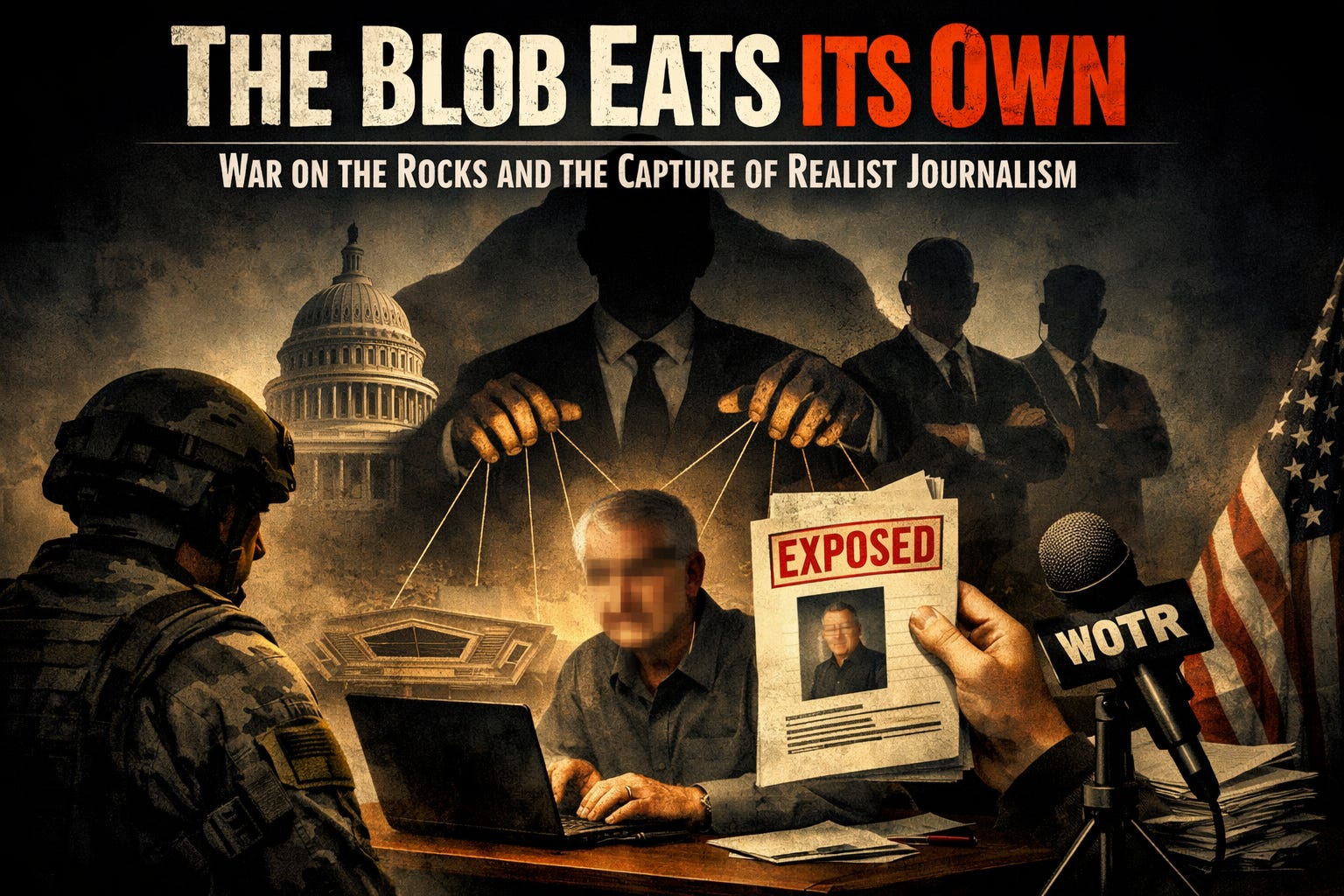
In March 2026, War on the Rocks published a rebuttal to a piece in American Greatness that had endorsed Secretary Hegseth’s review of the military’s senior service colleges. In the article’s opening, War on the Rocks printed the real identity of Cynical Publius, a retired Army officer who writes under a pseudonym for The Federalist, Tablet, and American Greatness. There was no journalistic justification for the disclosure given in the article. No fraud alleged. No public safety concern. No accountability angle. The pseudonymous author had committed no offense except criticism. War on the Rocks simply printed his name in a rebuttal to an article arguing the war colleges had lost their way. To understand why, you have to understand what War on the Rocks used to be — and what it became.
Here is what War on the Rocks published in its first years:
“Five Myths about AirSea Battle” — July 2013
“Don’t BS the American People About Iraq, Syria, and ISIL” — August 2014
“Here’s Why Women in Combat Units is a Bad Idea” — November 2014
“NATO’s Open Door Leads to an Identity Crisis” — June 2016
This was content that questioned official framings, challenged strategic consensus, and ran heterodox arguments the establishment found uncomfortable. The editors let practitioners argue.
Here is what it publishes now:
“How Democracies Can Defend Against Disinformation” — May 2018
“What the Air Force Can Teach the Country About Trust and Inclusion” — October 2020
“More Than a Buzzword: Diversity Can Help Defeat Disinformation” — May 2021
“How to Support a Globally Connected Counter-Disinformation Network” — January 2022
Social media censorship. DEI as national security imperative. The establishment’s preferred language dressed in national security drag.
Cynical Publius’s article was about military senior service colleges that had abandoned their original professional-education mission for ideological conformity. He called for reform under Hegseth. War on the Rocks is not a senior service college, but it underwent the same transformation he described: from a publication with a clear practitioner-focused identity to a platform running the establishment consensus. And the people now running WOTR are embedded in the same DoD apparatus that administers the institutions Cynical Publius criticized. The current Editor-in-Chief of Texas National Security Review — WOTR’s academic journal — simultaneously holds an appointment as Visiting Associate Professor of Research at the U.S. Army War College’s Strategic Studies Institute, a DoD institution. This dual role is undisclosed in her editorial biography. When War on the Rocks printed his name, a captured institution was, in effect, protecting captured institutions.
In July 2013, Ryan Evans launched War on the Rocks with $4,450 raised on Kickstarter. The campaign promised a platform for “debate on foreign policy,” and the founding post delivered an explicit methodology: a “realist lens” grounded in Hans Morgenthau and the Thucydidean triad of fear, honor, and interest. This was not decoration. Evans positioned WOTR against the foreign policy consensus.
The credibility behind this positioning was earned. Evans had spent 2010–2011 in Helmand Province as a civilian Human Terrain System social scientist embedded with British Task Force Helmand — not as a uniformed soldier, but as a DoD contractor. He came home, in his words to Nieman Lab, having been made “a lot more modest about what American power can accomplish in the world.” That modesty was real. The experience of watching American policy fail on the ground in Afghanistan gave Evans a perspective that Washington’s defense intellectuals — insulated by institutional affiliations and professional incentives — largely lacked.
But even then, Evans had already demonstrated a willingness to choose institutional opportunity over institutional critique. The American Anthropological Association had formally condemned the Human Terrain System on October 31, 2007, arguing that it endangered both social scientists and the populations they studied. Evans deployed three years after the condemnation was published.
In late 2013, General Martin Dempsey — Chairman of the Joint Chiefs of Staff — sought Evans out. Dempsey told Evans that War on the Rocks was the best way to reach the rank-and-file of the military. In February 2014, Dempsey gave his first ever podcast interview for the site. A Chairman of the Joint Chiefs chose a bootstrapped website six months old over every legacy platform in Washington. That endorsement cannot be manufactured. It validated WOTR’s credibility in a way that no foundation grant or masthead affiliation could replicate. That is what made the publication worth capturing.
The early funding model reflected the editorial independence. Crowdfunding first — Kickstarter, then Indiegogo, then $50-per-year reader memberships — supplemented by a single undisclosed angel investor. No foundation grant. No defense contractor sponsorship. No institutional patron whose preferences required management. WOTR operated as Metamorphic Media LLC, a private company rather than a 501(c)(3) nonprofit. Foundations cannot grant directly to LLCs, which meant the standard capture mechanism could not operate through normal philanthropic channels.
Evans pursued a PhD at King’s College London’s Department of War Studies alongside the site’s growth. He held an MA from King’s, but the doctorate was quietly abandoned around 2019 — no completion noted, no acknowledgment. He shed the credential the same way WOTR would later shed its “realist lens”: without explanation, without a forwarding address, as if it had never been part of the identity at all.
Smith Richardson Foundation is not a household name. This is by design. SRF operates below the visibility threshold of mainstream political journalism while functioning as one of the most consequential funders of American national security and foreign policy infrastructure. Its neoconservative grantees include the American Enterprise Institute, the Hudson Institute, and the Hoover Institution. CNAS listed SRF at the $250,000–$499,000 funding level as recently as fiscal year 2025.
Smith Richardson Foundation funds the institutions that supply War on the Rocks’s contributors: the American Enterprise Institute, the Center for a New American Security, the Hoover Institution. Nadia Schadlow served for many years as SRF’s Senior Program Officer for International Security, often a role which decides which of those institutions gets the grant. In November 2015, she joined WOTR’s editorial staff as a Senior Editor. The person deciding whether CNAS, AEI, and Hoover got their funding was now also deciding what ran in WOTR. Neither role was ever disclosed to readers.
No document shows Schadlow killed a submission or favored an SRF grantee. Such documents rarely exist. What is documented is the structure itself — and the fact that it was never disclosed. The undisclosed structural conflict of interest was present throughout every editorial decision from November 2015 until Schadlow departed in early 2017.
The departure itself is instructive. H.R. McMaster appointed Schadlow Senior Director for Strategy on the National Security Council in March 2017. She was elevated to Deputy National Security Advisor for Strategy on January 21, 2018 and is widely credited as the primary author of the 2017 National Security Strategy. The career arc ran from foundation program officer to the West Wing, with the WOTR editorial role as one node in the network along the way. The small publication that started on Kickstarter had become a credentialing institution for people moving into positions of genuine power.
The Schadlow position was the template.
On March 2, 2016, War on the Rocks published an open letter declaring Donald Trump “utterly unfitted” to serve as President of the United States. One hundred twenty-two Republican national security figures signed it. WOTR published the letter without editorial framing, without disclaimer, without any pretense of balance. The publication that had launched on a “realist lens” — skeptical of intervention, modest about American power — had chosen to amplify the voices of the establishment it once positioned itself against.
What the signatory list did not contain matters as much as what it did. Few, if any, structural realists appeared among the 122 names. No John Mearsheimer. No Stephen Walt. No Andrew Bacevich. No Barry Posen. No Christopher Layne. The intellectual tradition that WOTR was founded on was entirely absent from the letter it chose to publish. The realist lens had become a branding exercise, invoked when convenient and discarded when the establishment consensus required reinforcement. Among the signatories who did appear: William Inboden, former Senior Director on the Bush NSC.
Eighteen months later, in October 2017, Evans co-launched the Texas National Security Review — a peer-reviewed academic journal intended to complement WOTR’s practitioner content. The governance structure tells the story: at minimum seven of the 122 anti-Trump signatories hold editorial or advisory roles at TNSR according to its masthead is at least eight. William Inboden himself became founding editor-in-chief and remains on the TNSR Editorial Board today. Francis Gavin chairs the TNSR Editorial Board. Gavin had appeared on WOTR’s own podcast in March 2017 in an episode titled “In Defense of the Blob”, arguing that listeners did not appreciate how well-served they were by the foreign policy establishment.
TNSR is not a separate institution. It is the network of WOTR, formalized.
In April 2020, Hal Brands, Peter Feaver, and William Inboden published a separate piece — also titled “In Defense of the Blob,” this time in Foreign Affairs — the most prominent recent defense of the foreign policy establishment in any major venue. The bylines map the network precisely. Brands held the Henry A. Kissinger Distinguished Professorship at Johns Hopkins SAIS and sat on the TNSR Editorial Board. Feaver directed the Program in American Grand Strategy at Duke, had served in the Bush NSC as Special Advisor for Strategic Planning, and also sat on TNSR’s Editorial Board. Inboden had co-signed the anti-Trump letter with Feaver four years earlier, built TNSR from that letter’s network, and was still running the journal when the piece appeared. Their collective argument: the foreign policy establishment “is not the problem. It is the solution.”
Consider the trajectory. The publication that launched in 2013 to challenge Washington’s foreign policy consensus with Thucydidean realism had spent seven years constructing the institutional infrastructure that produced the consensus’s most prominent self-defense.
On March 22, 2022 — twenty-six days after Russia’s invasion of Ukraine — the “realist lens” disappeared from WOTR’s About page. The March 21 Wayback snapshot preserves it. The March 22 snapshot does not. No announcement accompanied the deletion. No editor’s note explained the change. No acknowledgment that the founding identity had been excised. The same edit added “owned and operated by Metamorphic Media LLC” corporate branding where the ideological marker had been. The founding identity out; the commercial identity in.
Capture was already complete by March 2022 — had been complete for years. The deletion simply meant someone had decided it was finally safe to update the website. The war in Ukraine made realist arguments about restraint and spheres of influence politically toxic. The last trace of WOTR’s founding intellectual identity became a liability and was quietly removed.
The British dimension of the network warrants brief note. Two professors from King’s College London’s Department of War Studies — Evans’s graduate institution — serve as WOTR Contributing Editors. Lawrence Freedman is Emeritus Professor. John Bew served as Boris Johnson’s chief foreign policy adviser at 10 Downing Street, a position he held through four successive prime ministers. The Royal United Services Institute, the think tank most closely associated with this network’s British dimension, lists the U.S. State Department as its second-largest funder at £500,000 to £999,000 per year according to Declassified UK. The consensus machine runs on both sides of the Atlantic.
In August 2024, WOTR announced that Sheena Chestnut Greitens would become Editor-in-Chief of the Texas National Security Review. The website announcement cited her Harvard doctorate, her Carnegie Corporation nonresident scholar position, her published work on authoritarian institutions and Chinese security policy. It did not mention that she simultaneously holds appointment as Visiting Associate Professor of Research in Indo-Pacific Security with the China Landpower Studies Center of the Strategic Studies Institute, U.S. Army War College. SSI is a DoD institution. It produces strategic assessments for Army and joint force leadership. The person editing the peer-reviewed journal that covers American military policy is on the DoD payroll.
TNSR is not a separate institution from War on the Rocks. Evans co-founded both. WOTR has described TNSR as its peer-reviewed complement. The editorial boards overlap directly. What runs in one reflects on the other. When WOTR published the name of Cynical Publius — a retired Army officer arguing the senior service colleges had drifted from their warfighting mission into ideological conformity — the journal’s editor-in-chief was simultaneously embedded at one of those senior service colleges. The Army War College is exactly the kind of institution Cynical Publius was arguing needed reform. The academic journal arm of the publication that identified him by name is edited by someone on its research institute’s payroll.
War on the Rocks has no published ethics or conflict-of-interest disclosure policy. After twelve years of publication. After covering every major American military engagement of the past decade. After accepting a grant from the MacArthur Foundation for nuclear policy programming. After entering a named editorial partnership with Booz Allen Hamilton — a defense contractor with billions in active government contracts — for its defense technology vertical. No written standard exists for when contributors must disclose institutional affiliations, funding relationships, or government roles. After twelve years, this absence is a choice — a choice that happens to benefit everyone at the publication who would otherwise be required to disclose something.
The United States has not won a war in decades by any honest accounting. The foreign policy expert class that produced that record has also been the class explaining it — analyzing its own failures in publications funded by its own institutions, staffed by its own alumni, peer-reviewed by its own network. The apparatus does not suffer from a shortage of credentialed analysts. It suffers from a structural inability to receive the kind of criticism that would require it to change.
War on the Rocks was initially founded as the antidote to exactly that problem. Ryan Evans built a platform for the practitioners who had lived the policies — because they knew what those policies had produced on the ground, and the established journals wouldn’t say it plainly. That is why the Chairman of the Joint Chiefs sought him out. That is why rank-and-file soldiers read it. The credibility was real because the critique was real.
Fast forward twelve years later.
Cynical Publius is a retired Army officer. He served. He came home. He argued — under a pseudonym, because the institutions he was criticizing have real power over his professional world — that the senior service colleges had drifted from warfighting competence into ideological conformity and required reform. He was doing, in other words, exactly what War on the Rocks was built to make possible: a practitioner speaking plainly about institutional failure.
War on the Rocks printed his name in the opening argument.
That is the tell. Not the funding, not the network, not the deletion of “realist lens” from the About page — though all of it is documented. The tell is this: the publication that was supposed to be the honest after-action review became the institution that shuts it down. The correction mechanism became the immune system. When someone tried to do the work the publication was founded to do, the publication exposed him to the people he was criticizing and let them take it from there.
The people tasked with explaining why America keeps losing are the same people defending the institutions that produced the losses. War on the Rocks stared into the abyss for too long, and the abyss stared back and claimed them.
War on the Rocks has unwittingly became the perfect case study for why military reform is urgently needed.